By Joe Mauriello, in collaboration with Insight Navigator (a ChatGPT bot created as a tool for Intelligence Augmentation). With special attribution to John Kellden for the cards and materials used to create the Insight Navigator bot.
When I was very young I wanted to be an archaeologist. I wanted to assemble dinosaur bones. The idea that creatures of unimaginable scale once roamed the earth was an incredible draw. I read books on the subject, I had a collection of plastic dinosaurs, and even relished in the assembly of wooden kits to model them. Other toys included bags of fossils and a block of soft stone that I soaked in water to soften the top layer of dirt to excavate the skeleton of a miniature stegosaurus.
Toys invite play. I still surround myself with toys. Little ones. Finger scale. Particularly building toys. I find them irresistible. I had a friend once, who would call a good idea he was cooking up ‘a toy.’ To him, an idea sat physically in his mind, something he could turn over and reorient, like a scaled model or puzzle pieces. I’m a spatial thinker, so this resonates with me.
Card: Play
Play is the act of
engaging with the world through
discovery and experimentation,
uncovering hidden possibilities, and
revealing new pathways in the familiar.
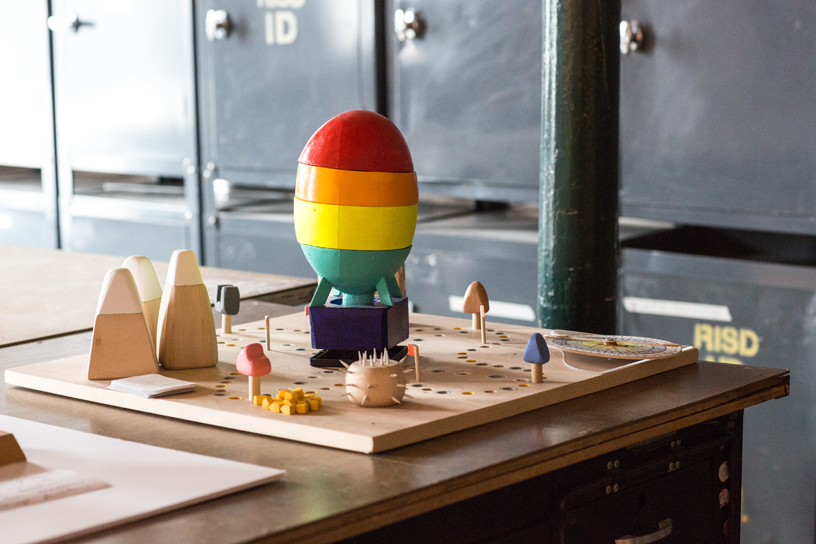 Image source: https://digitalcommons.risd.edu/industrialdesign_masterstheses/
Play invites us to engage with the world not as it is, but as it could be—a space where curiosity, experimentation, and creativity thrive. It provides a way to reimagine constraints as opportunities, a necessary skill for navigating complexity. When I was preparing to leave my childhood home to make my way in the world, I was stubborn to give up play. While nearly all examples of adult success demonstrated a grim resolve– Why so serious? I wanted to play! That’s likely how I chose the arts as my educational path. I picked what I thought was a practical field of study, industrial design; physical product design, while still offering the chance at play.
“So I’ll get to use this amazing collection of tools and materials to design and model beautiful objects that people would use everyday?” I was in.
At first I thought I’d try architecture, but the tools in the industrial design department were so much cooler, and the focus on hand held objects seemed more fun. Though I’ve made many career pivots since that first decision to pursue an arts degree, play, optionality, and the potential to craft experiences has always remained at the center of my vocation.
Card: Search
Search and find.
Explore insights that
drive entanglement,
collaboration and holism.
Through play, we uncover possibilities. Through search, we map those possibilities into patterns, shaping the relational fields that guide our next steps. I have always believed that a sense of play is more than a childhood pastime. It wasn’t until I was well into my adult years that I learned I wasn’t alone in my approach to vocation. Karen Barad, a physicist and philosopher, explores the concept of ‘entanglement,’ offering a lens through which play and vocation become deeply interconnected. She reminds us that objects, actions, and ideas are not isolated but emerge through relationships and interactions. The tools I used in my industrial design education—the saws, molds, and prototypes—were not just instruments of creation but co-agents in my creative process. They entangle with my ideas and intentions to shape what I could imagine and make, blurring the lines between the creator and what is created.
When it came time to graduate and pick a profession, the job market for industrial designers included the design of watches, pens, and picture frames at companies like Gillette, Bic, and Timex. As one who was determined to stay playful, I couldn’t see myself making a career out of these objects, working at these companies. They didn’t seem to fit my vocation. I wanted to create experiences of play. This was my first pivot. Led by my curiosity and love of play, I decided I would make games.
Card: Game
Engage in structured
interactions towards
narratives conducive to
behavior turned agency
My parents gifted me a Nintendo Entertainment System for Christmas in 1987. Even through my college days I loved playing games. Halo matches between friends lasted long into the night. Games and play go together, right? I wanted games as part of my vocation.
To return to Barad, her concept of entanglement offers insight into why simply playing games wasn’t enough for me—I wanted to be part of their making. Games are not just designed objects; they emerge through an interplay of ideas, interactions, and material. In the case of digital games, the materials are bytes, electrons, silicone, and the input devices like the boxy NES controllers I first put my hands on. Designing games means stepping into a web of relationships, shaping tools, mechanics, and stories to craft experiences that invite others into play. Barad reminds us that creation is not a solitary act; it’s a collaborative intra-action with the materials, systems, and communities we engage with. For me, making games was about stepping into that relational process and contributing to a medium that had shaped so much of my own vocation to that point.
Card: Modes of Thought
Philosophy begins with "assemblage" - gathering
diverse ideas without rigid systematization.
This open exploration allows for the emergence of
unforeseen connections, enhancing and expanding
our understanding of the world.
Karen Barad plays this card (figuratively) to challenge the traditional boundaries of the social sciences, which are often rooted in material dualism—the idea that spheres governing mind and social interaction must be kept separate from those studying physical phenomena. She brings together experimental science and philosophy, confronting her with a model of reality that goes beyond classical frameworks; the ones that have underpinned western thought and society since the enlightenment. René Descartes, dissatisfied with the rigid systemization of church doctrine (Scholasticism) of his own time, sought a new foundation of knowledge. In order to realize this new foundation without upsetting the dogma of his time, Descartes had to divide mind from matter. The mind belonged to the realm of the metaphysical while the rest became the domain of human works and senses.This division freed Descartes and everyone thereafter, to apply thinking in previously unimaginable ways with this new concept; the material world. Descartes also gave us the cartesian coordinate system, a means to order and compare anything that might be measured. This divorce caused a rift that continues to ripple through our entangled relationship with the world we construct and the more-than-human-world we are embedded within. Indeed this division creates a crisis, where we can’t stop ourselves from disassembling and reconfiguring the world’s living processes into structures that provide us feelings of comfort, security, and enduring existence.
The pull of my attention towards this division continues to evolve and shape my vocation. I’m drawn to play there. In my early career, I focused on games for entertainment, but I found a growing affinity for games that could do more than merely entertain. Marshall McCluhan spoke of the agency of media and it became clear to me that even games for entertainment had a point of view, they created a relationship with players. I saw this in myself and my friend group, playing long hours of Halo. Standing in line at midnight to score a copy of Halo 2 on release day only to come home and play it well into the morning and indeed the next day. What value did this provide to me? Certainly a bond with my friends, that I am still friends with to this day. What values were the games expressing through me? This is harder to say.
The universe offered me an opportunity to do something different with games, well before these inklings became a clear point of view. I was offered a position at Amplify Education as a game design researcher. I didn’t know much about research at that point, but I knew I wanted to design games. So I took the job. Not only was I afforded the opportunity to work in the field of game design, the games were specifically oriented to infuse learning through play. Justin Leites, the architect of Amplify's educational games approach, didn't wish to build educational games that popped a math quiz in amongst moments of game play (coined chocolate covered broccoli by Amy Brukman way back in 1999), but instead set out to deeply integrate learning objectives into the game systems. Justin’s vocational path wound through fields of games, politics, and academics. It seems Justin also was pulled to a turn towards play, leaving a role at the UN to form the game’s team. I was fortunate to be a member of his team at Amplify, as it put me into relationship with a set of ideas and methods that deeply resonated with my vocation, my deepest curiosity, that I might not have found access to otherwise.
Card: Search
Search and find.
Explore insights that
drive entanglement,
collaboration and holism.
Newton leveraged the new foundation, afforded by Descartes, to offer a model of physics that seemed complete but for a few loose ends. Bertrand Russell was so emboldened by the Cartescian paradigm that he embarked with his teacher, Alfred North Whitehead, on a multi-volume work on the foundations of mathematics. The Principia Mathematica attempted to enclose the logical universe of mathematics— a study that bridges the divide of mind and matter, but they hit a snag. Gödel’s Incompleteness Theorem revealed a profound limitation: no formal system can fully explain itself. This crack in logic mirrored the growing cracks in the Cartesian framework of mind and matter. By attempting to do for mathematics what Newton seemed to do for physics they revealed a serious crack in the wall between mind and matter. This crack, illuminated further by quantum mechanics, signals the limitations of rigid systemization—a gentle cue for us to think relationally and holistically. In the late 19th century, just a few decades before Russell’s and Whitehead’s failed attempt, experiments with light showed a need to revisit underlying assumptions about the fundamental nature of the universe as well. Quantum physics brought a revolutionary shift in our understanding of the universe, but rigid systemization has a way of persisting even in the face of dissonance.
“God does not play dice”
— Albert Einstein
Card: Orientation
Orientation builds on observation
to weave knowledge, values, and
perspectives into a coherent
sense of where we are—conceptually,
physically, and socially. It shapes how we
relate to the world and our role within it.
When reflecting on assemblage, orientation is a lens that helps to distinguish figure and ground, perspective and holism, vector and field. If our vocation is the vector, the thing that drives us, then the conceptual, physical, and social landscape that we inhabit and navigate is the field. We co-create the field. Karen Barad’s assemblage of quantum physics and feminist theory provides a powerful lens for understanding vocation as a vector moving through a relational field. Her work integrates insights from quantum mechanics (like entanglement and intra-action) with the ethical and political principles of feminist theory, creating a framework where agency and action are inseparable from the contexts in which they occur.
The dual slit experiment reveals that the act of observation collapses a wave function of light into a particle-like state. Barad played with this interpretation using its results to emphasize the relational, performative nature of reality that underpins her concept of agential realism. Barad argues that matter and meaning are inseparable and emerge through intra-action, a term she uses to describe the co-constitutive relationship between entities. Objects are defined by their entangled relationships. Alfred North Whitehead, spurred on by his failed attempt to enclose mathematics, explored similar ideas nearly a century earlier. Where Barad talks in highly active verbiage with intra-action, Whitehead had a similar concept that he called “actual occasions.” With this framing he shifted the objectification of reality away from instances and towards events. Where Barad talks of entanglement, Whitehead spoke of concrecense—a process of becoming where diverse influences (material, experiential, and relational) coalesce to create a unique entity or event. Whitehead coined the term "creativity" as a fundamental metaphysical principle, driving the emergence of novelty in the process of becoming. Both Barad and Whitehead move us away from fixed structures and toward processes of becoming—where creativity and entanglement continuously shape what is possible. Is this the essence of play?
Play precedes game design. Play is what we do in relation to each other and the objects of mind and matter. A ball is a toy. We play with a ball by kicking it, throwing it, catching it, and finding the fun in those events. Through patterns of play, we can construct rules that deepen and extend our relationship through time and space. We play our games “on” a field.
Source: https://johnkellden.medium.com/cards-for-insight-2023-c94ca8a8bdc7
Card: Play
Play is the act of
engaging with the world through
discovery and experimentation,
uncovering hidden possibilities, and
revealing new pathways in the familiar.
Card: Game
Engage in structured
interactions towards
narratives conducive to
behavior turned agency
…Navigate your vocational pathway by uncovering hidden possibilities, crafting narratives, and transforming behavior into agency...
The 21st century is marked by a turn towards crisis. Climate, economic, social, and political fields are all flashing red warning signs. I wrote this article after my region was hit with what was narrativised as a “bomb cyclone.” This was concurrent with the Biden administration authorizing Ukraine to use long range missiles to fire deep into Russia, a red line established by the Kremlin. Billionaire, reality TV star, embattled and divisive former president, Donald Trump was swept into office earlier this month by an US working public hoping for economic relief; a desperation move by the voting public. My power was out for more than a week—in fact, my electricity just returned while typing this paragraph.
These crises, each a wicked problem on their own, all compound to create an opportunity to play into aliveness. Play invites us to embrace uncertainty, co-creating solutions that transcend traditional boundaries. In a world marked by dissonance, play becomes an act of resistance and regeneration—an opportunity to move from fragmentation to connection.
I wrote this piece as a way to process the ongoing and unfolding crisis. The cards used throughout the article are a structured part of an ongoing process I’ve been exploring with my friend, John Kellden. Affinity drew me to the work John has been pursuing in his own vocation. These cards offer a means to focus attention, arrange ideas, and launch card play participants into collaborative sense making, turning our behavior towards agency.
Let’s play together. Use the pattern of play above (the text between the ‘...’) and the cards throughout this article to enact your own vocational pathway. You may be surprised by what you find. For example, before writing this article, while playing the cards alongside my AI/IA companion, I knew that games and play were a part of my vocation, but I didn’t realize how central the materials of play were to my vocational path until I reflected on my discursive relationship to those things were through this writing.
The way I played the cards while writing this article is but one way to do it. They work across contexts. John, myself, and a few others are starting a card play studio. We have open studio sessions and all are invited to play. What tools, relationships, or ideas shape your field? How do they entangle with your vocation? Sign up to be notified of open studio sessions.
“Let’s play together—not as isolated individuals, but as co-creators of a world that reflects our shared affinity and aspirations. In this shared field, our vectors can entangle to transform crisis into opportunity.
