A practical guide from Oxedge, Dubai · November 2026
A clinic brand has a harder job than most. It has to look calm and competent to a nervous patient, readable to a referring doctor, and consistent across a reception desk, an appointment reminder on WhatsApp, an insurance form and a sign on a busy Dubai road. In the UAE it also has to do all of that in two scripts. This guide walks through how a clinic, dental practice, physiotherapy centre or diagnostic centre in Dubai can plan a bilingual brand identity that patients trust and staff can actually use, and what to ask an agency before you sign.
Why healthcare branding in Dubai is different
Most businesses can get away with a logo that only looks good on a website header. A clinic cannot. Patients meet the brand in moments of stress: searching for a specialist late at night, reading a referral letter, finding the right entrance in a medical building with ten other tenants. Every one of those moments is a test of clarity before it is a test of style.
Three things make the UAE case special.
- Two scripts, equal weight. Many patients read Arabic first, many read English first, and plenty switch between them during one visit. Signage rules in Dubai often expect Arabic to be shown, and frequently placed before English. A brand that was designed in English with Arabic "added later" looks unbalanced on exactly the surfaces patients see most.
- Regulated, trust-heavy communication. Healthcare marketing is closely watched. The identity has to support plain, factual messaging: doctor names, specialties, licences, opening hours, insurance accepted. Visual noise and gimmicks work against you.
- Many touchpoints, many suppliers. A typical practice deals with a fit-out contractor, a sign maker, a printer, a uniform supplier, a booking system, a website developer and a social media freelancer. If the brand rules are vague, each of them interprets the logo differently.
Start with the brief, not the logo
Before any sketching, a good identity project for a clinic answers a short list of questions. Write them down; they become the yardstick for every design decision later.
- Who is the patient? Families with children, executives using corporate insurance, athletes, older residents, medical tourists? Each group reads tone differently.
- What should the patient feel at the door? Reassured, cared for, in expert hands, welcomed. Pick two words and hold the designer to them.
- What does the name do in Arabic? Is the Arabic name a transliteration of the English one, a translation, or a different name altogether? Your Arabic trade name on the licence is usually a transliteration, and that choice affects letterforms, length and how the logo stacks.
- Where will the brand live? List every real surface: building sign, door vinyl, reception wall, appointment cards, prescription pads, lab report headers, scrubs, the booking page, Google Business Profile photo, Instagram, WhatsApp profile picture.
- Who are the neighbours? Look at the clinics around you and online. If every competitor uses the same teal cross, that is a reason not to.
At Oxedge every identity is quoted after a 30-minute brief for exactly this reason: a logo for a new single-doctor practice and a rebrand for a group of clinics are very different jobs, and the quote should list every deliverable, round of changes and timeline before you sign.
Designing the mark in two scripts at once
The single most common problem we see on Dubai clinic signs is a strong Latin logo next to Arabic set in whatever system font was on the sign maker's computer. The weights do not match, the Arabic sits too low or too small, and the two halves look like two different companies.
The fix is simple to describe and takes skill to execute: design both scripts together, from the first sketch. That means:
- Matching visual weight. Arabic letterforms have different proportions, so "the same font size" does not produce the same presence. Stroke thickness and overall colour have to be balanced by eye.
- Agreed height and baseline relationships. Arabic has more vertical movement than Latin. Decide how ascenders, descenders and dots relate to the English cap height so the lockup feels like one unit.
- Lockups for every layout. A horizontal version for fascia signs, a stacked version for square spaces and social avatars, an icon for favicons and app tiles, and clear rules for Arabic-left or Arabic-right arrangements.
- Small-size testing. A clinic logo has to survive as a 32-pixel WhatsApp avatar and an embroidered chest logo on scrubs. Fine Arabic detail that disappears at small sizes needs a simplified version.
If you want to go deeper on the reading-direction side, Oxedge's Arabic-first UX guide covers many of the same traps on screens.
Colour and type that work under clinical conditions
Clinics are full of hard lighting, white walls and printed forms. Colour choices that look sophisticated on a designer's monitor can fail under fluorescent tubes or on a cheap laser printer at reception.
Colour system. Build a palette with a primary brand colour, one or two supporting colours and a set of neutrals, each specified for screen (HEX/RGB), print (CMYK) and signage or paint where relevant. Check contrast for text: patients with limited vision, older patients and anyone reading a phone in sunlight need strong contrast. Avoid relying on red and green alone to carry meaning.
Paired typefaces. Choose a Latin family and an Arabic family that feel related in tone and weight, and define which weights are used for headings, body text, forms and signage. Make sure licences cover web, print and app use, so your web developer and printer are not quietly swapping in substitutes.
Iconography and imagery. Decide early whether you use photography of real staff and rooms (usually best for trust), illustration, or both. Set rules for how people are shown, especially for modesty and cultural sensitivity.
The patient journey as a design checklist
Instead of approving a logo on a white page, test the identity on the moments a patient actually lives through. We design and test identities on real pieces, such as a website screen, a sign, a social post or a box, so you see the brand in use before you approve it. For a clinic, a useful test set looks like this.
| Moment | What the patient sees | What the brand must do |
|---|---|---|
| Search and discovery | Google profile, website, Instagram | Clear name in both scripts, readable avatar, consistent photos |
| Booking | Booking page, WhatsApp chat, confirmation message | Same colours and tone, clinic name and address unmistakable |
| Arrival | Building directory, fascia sign, door vinyl | Arabic and English balanced, legible from distance and at night |
| Waiting | Reception wall, screens, forms, leaflets | Calm layout, plain language, consistent type |
| Treatment | Scrubs, name badges, treatment room signage | Small-size logo that survives embroidery and print |
| After the visit | Invoice, report header, follow-up reminder | Professional templates, contact details correct everywhere |
If you run this table for your own practice, gaps usually jump out: an old logo still on the invoice template, an Arabic name spelled two ways, a WhatsApp avatar cropped so the mark is cut off.
Print pieces a clinic really uses
Healthcare runs on paper more than most people think. A complete identity for a practice normally includes templates for the pieces staff touch every day, not just the glamorous ones:
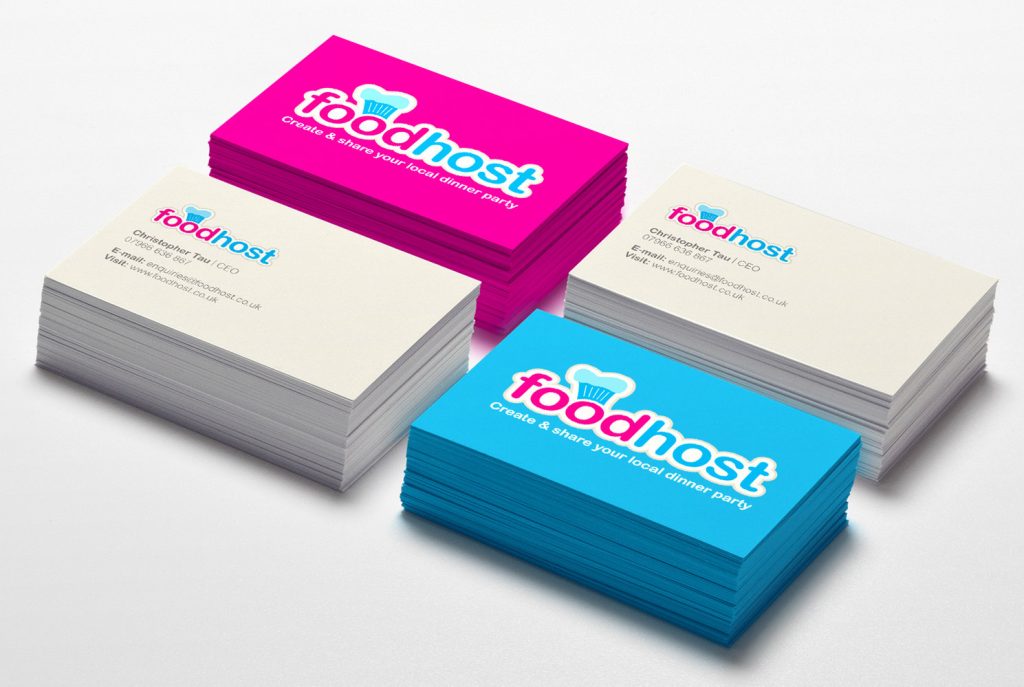
- Business cards for doctors and managers, in both languages
- Letterheads and referral letter templates
- Invoice, quotation and receipt templates that match your accounting or practice software
- Patient information leaflets and consent form layouts
- Appointment cards and prescription or report headers
- Presentation templates for partners, insurers and medical conferences
- Brochures for referring doctors, which need a different, more technical tone than patient leaflets
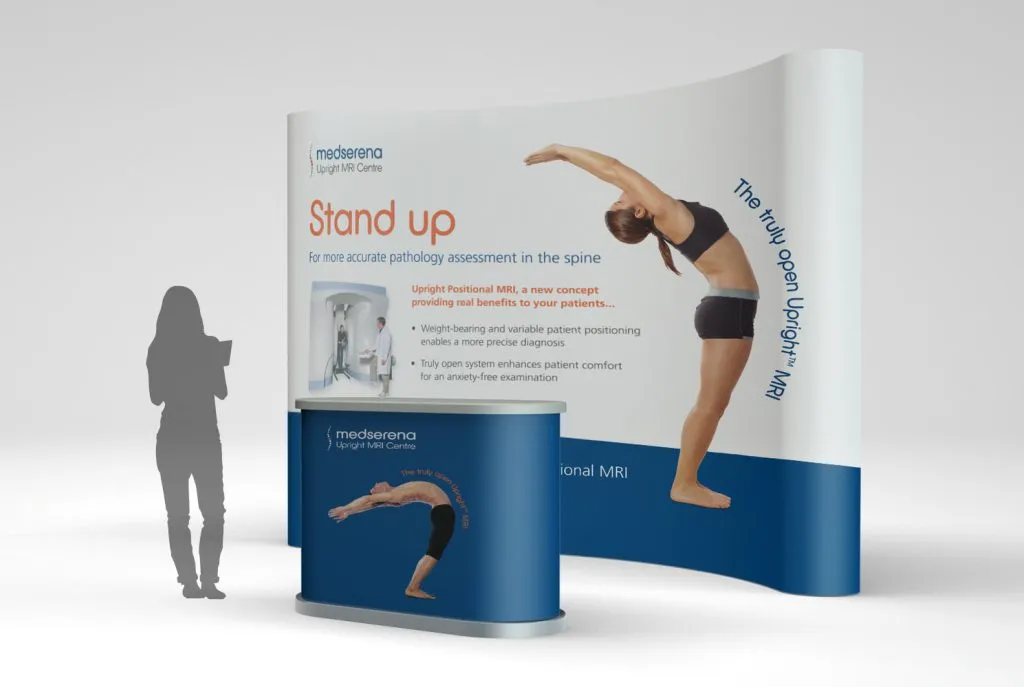
- Exhibition stand graphics if you attend health events
The point of templates is that your team can produce new material on Monday morning without calling a designer for every leaflet. That is also why brand guidelines matter.
Brand guidelines your suppliers will follow
Guidelines do not need to be a 90-page book. For a clinic, a clear document of 15 to 30 pages usually does the job if it covers:
- Logo versions, minimum sizes and clear space, in English and Arabic
- What not to do: stretching, recolouring, separating the scripts, placing on busy photos
- Colour values for screen, print and signage
- Type hierarchy for both scripts, with examples of headings, body text and form labels
- Photography and tone-of-voice guidance, including how to describe services factually
- Signage examples with Arabic and English placement
- Social media rules for avatars, post templates and story covers
- Template files and where they live
Send the guidelines with every supplier brief. When the sign maker, the printer and the social media freelancer all work from the same file, the clinic starts to look like one organisation.
The digital side: website, booking and messaging
Patients increasingly judge a clinic by its website and messaging before they ever call. Your identity should be designed with these screens in mind from day one: colour contrast that works for buttons and forms, an icon that reads as a favicon, and Arabic type that renders well on the web.
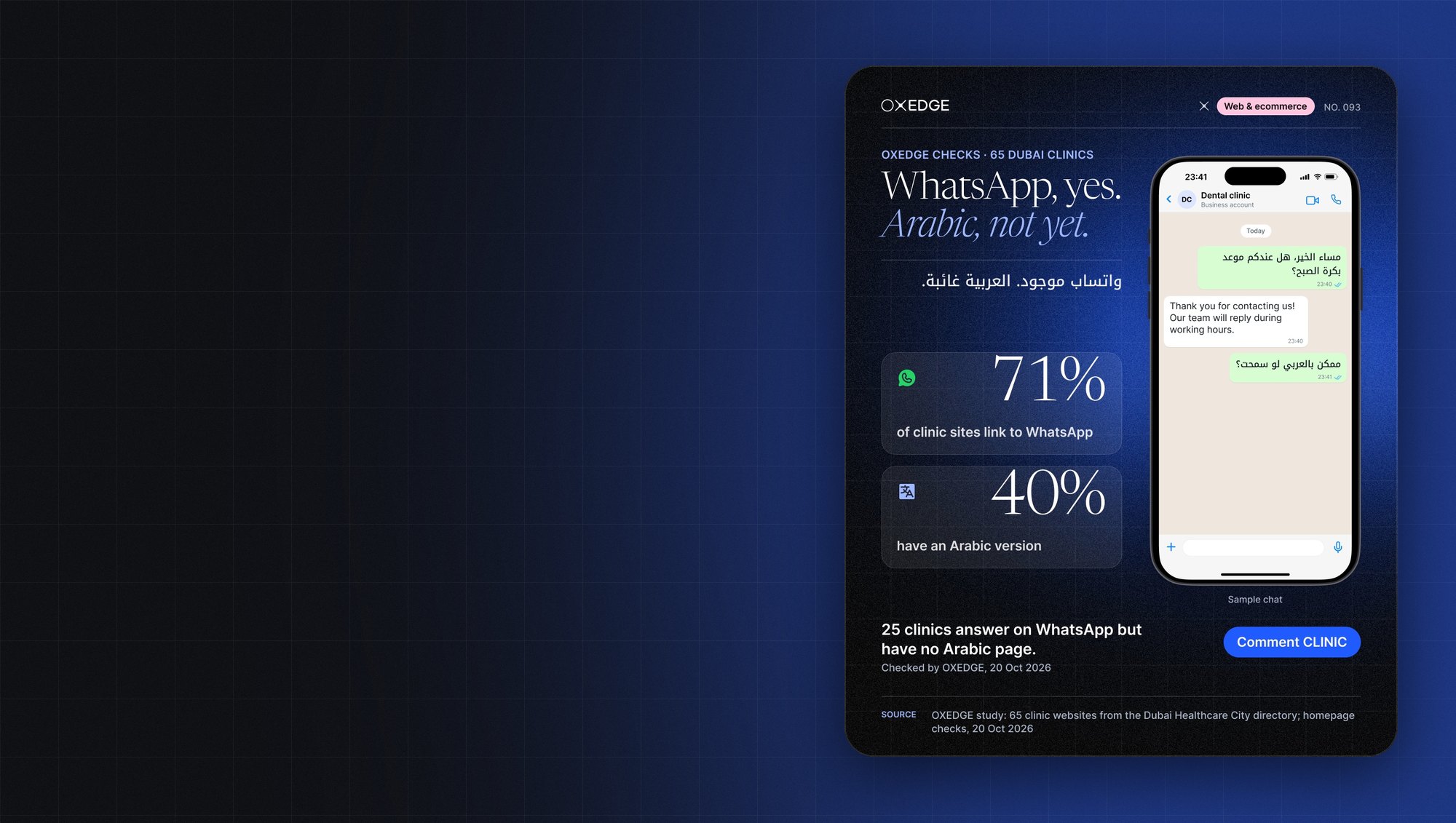
A bilingual site needs more than translated text. Structure, navigation, right-to-left layout and search visibility all have to be planned for both languages; our guide to building a bilingual Arabic-English website in the UAE explains the decisions involved. Clinics should also look at how patients actually find and book care online; the Dubai clinic websites study looks at booking, Arabic and WhatsApp on real clinic sites.
Your social media kit should include profile images for Instagram, LinkedIn and WhatsApp, cover images, post and story templates in both scripts, and a simple guide for whoever posts day to day.
Refresh or full rebrand?
Not every clinic needs to start from zero. If patients already recognise your name and mark, a refresh may be enough: redrawing the logo cleanly, adding a properly designed Arabic version, tightening colours and building templates. A full rebrand makes sense when the name is changing, groups are merging, the practice is moving upmarket, or the current identity simply cannot be fixed.
As a rough planning guide, a logo refresh usually takes 6 to 10 weeks and a full rebrand 10 to 16 weeks, including testing on real pieces. If the name is changing, start the trademark filing as soon as the name is chosen; UAE government fees are AED 6,500 per class. A rebrand also touches licences, permits, signage approvals, insurance listings and online profiles, so plan the switch-over date carefully. Our article on rebranding a UAE business lists what to update.
What you should receive at the end
Whoever designs your clinic brand, insist on owning it. At the end of an Oxedge identity project you receive the master vector files, PNG and SVG exports, print-ready PDFs, the brand guidelines and a written transfer of rights. Payments run in milestones of 40%, 40% and 20%, and prices exclude 5% VAT.
Before you sign with any agency, ask:
- Will the Arabic and English versions be designed together, by someone who reads Arabic?
- Which real pieces will you test the identity on before I approve it?
- How many rounds of changes are included, and what happens after that?
- Which files and templates are included, and in which formats?
- Do I receive full rights in writing?
Frequently asked questions
How long does it take to brand a new clinic in Dubai? A focused identity for a new practice, including the bilingual logo suite, colours, type, guidelines and core templates, typically fits within the 6 to 10 week range of a refresh. Larger groups with many locations and pieces take longer. Leave time for sign fabrication and approvals after the design is final.
Should the Arabic name be a translation or a transliteration? Most clinics use a transliteration so the name sounds the same in both languages and matches the trade licence. A translation can work for descriptive names, but check meaning, tone and length with native speakers before committing.
Can we keep our existing logo and just add Arabic? Sometimes. If the current mark is well drawn and recognised, a designer can create a matching Arabic version and rebalance the lockup. If the original was built without Arabic in mind, a light redraw of both scripts usually gives a better result.
What does a clinic branding project cost? It depends on scope: a single practice needing a logo and a few templates is very different from a group rebrand with signage, uniforms and exhibition graphics. Oxedge quotes every identity after a 30-minute brief, with deliverables, rounds and timeline listed before you sign.
Talk to Oxedge
Oxedge designs logos and brand identities for UAE businesses, with English and Arabic drawn as a pair, from the logo suite and guidelines to packaging, print and exhibition graphics. See the service at https://oxedge.com/logo-design-branding-dubai/ (Arabic version: https://oxedge.com/ar/logo-design-branding-dubai/), or visit Oxedge.
Oxedge · Office # 208, Bu Shaqer Building, Al Garhoud, Dubai · +971 50 815 3521 · info@oxedge.com · Monday to Saturday, 9am to 5pm (Sunday closed)